


Hey, friends. Welcome to the second edition of Social Notes.
If you’re new here, welcome! This month, I’m gonna talk about boring social.
So, in my career, I’ve talked to enough social media managers from different industries to know that there is something that gnaws at nearly all of us which is, “how do we make content that isn’t shit boring? And how can we flourish if we work in an industry that is, objectively, (very) boring?”
By the way, I just got back from Drive, a B2B Marketing conference hosted by Exit Five, and I can tell you that that is very top of mind for a lot of marketers, even if they don’t specifically own social.
My friends, I’ve worked in some deeply DEEPLY unsexy industries. I’ve done social for a diesel fuel company. A VoIP service provider. A e-signature software! I daydreamed about working for a glamorous fashion brand like Vogue or a really unhinged, chaotic wild brand like Liquid Death. I foamed at the mouth at the thought of having more—more resources, more opportunities. Or even just having a household name that people already recognize.

But something that I realized in the midst of admiring all the glam bam things is that there’s a very specific skill that you develop from working in an unsexy industry with limited resources (I’m talking next to $0 in terms of budget) and still being able to find a way to make it interesting. And that’s something that I’m deeply proud of. If I have a claim to fame in this career, I think that’s probably it. And in case you ever need a reminder that you’re doing just fine, remember this:
There are more of us (boring brand-ers) than there are of them

When I say “them,” I mean that most of use are not running social for Vogue magazine or Liquid Death with household name recognition, ginormous budgets and a full fledge creative team behind us. For most of us, we’re just trying to make something that is objectively less interesting a little more interesting for people online.
Most social teams are hanging on and figuring things out as they go. They’re told to do more with less, and then to make it even tighter. They have limited resources. They get shit support. And when social doesn’t perform fast enough to satisfy everyone’s desperate need for instant gratification, they’re chastised for it.
I rarely meet a company that doesn’t want social to work. It’s 2026. Everyone sees the value of it now. They want more reach. More relevance. Everybody is begging for more attention. They just don’t always know what good social looks like for them and they’re so deeply terrified of screwing it up.
It’s the kind of uncertainty that makes this job really hard because it gets pushed onto social teams to try to “make it work” somehow. They say, “grow the channel,” “come up with (better) ideas,” “prove value!!!” and “also don’t do anything that would make us uncomfortable.”
When I consulted with brands, one of the first questions I’d inevitably get was, “why do you think our current social strategy isn’t working?” And I look at their bright eyes and curious faces and see how desperate they were to hear something profound. The secret sauce their team must’ve missed. The golden answer from the LinkedIn marketing girl!
And I’d demolish their soul by saying, “I don’t think you have a social strategy.”

It’s usually a distribution plan for a bunch of half baked content ideas. Or you have a social team that is spending more of their energy trying to prove that social matters to people who hired them. I mean, look, I could give people five new formats tomorrow and maybe, by some stroke of luck, one of them pops off. Maybe they’ll get a nice spike in engagement. But overall that’s a bandaid fix. A new format doesn’t fix a company that won’t take risks. It doesn’t fix unclear ownership and I will be the first to tell you that it doesn’t fix a social team that’s clawing at the bottom of the barrel for whatever scraps the rest of the company is willing to give them.
Stop taking social advice so literally
Sometimes I think we make things even harder on ourselves because we do shit like looking outside of our very ordinary operating environments for answers and then borrow tactics from brands that are playing an entirely different game.
We see other companies and people do things online and immediately try to copy their tactics. I’ll use an example from my industry, B2B SaaS. Everyone is pushing for founder-led content because “no one follows brands anymore, they care about the people behind the brand” and yes, there’s truth to that. But now you have all these founders hiring the same ghostwriters, filming their talking heads and becoming these glorified product marketers in a way. And maybe that’s great when you have a founder who already has an interest for sharing online. But if you have to drag a founder up, kicking and screaming, just to post then that’s not a great use of anyone’s time. Same with a founder who absolutely looks miserable on camera, but everyone is saying video is king.
A broader example is when we tell teams to jump on trends because another brand did it. We show them a gorgeous feed and tell them their content needs to look just like this. But we don’t acknowledge that they probably have a team of photographers and designers behind the scenes, helping them look that way.
I ran a workshop recently where I talked about how we use creators at Slate, and afterward someone from a compliance company came up and asked, “so how would I find compliance influencers?” I thought that was interesting because he had framed it almost as a reason why they couldn’t work with creators. In my head, I was like, why would you specifically need a “compliance influencer”?? Couldn’t you just find someone who could speak credibly about the problem that your audience has? And then I realize that he was trying to figure out how he could replicate my creator strategy literally. And to be fair to him, I was probably not clear enough about why the program worked which ultimately made it harder for him to translate this idea into his world.
We do this with social content all the time. We copy the artifact instead of the thinking behind it.
We tell our team to jump on trends because others did it. We point to some unhinged campaign that went viral and say, “why don’t we do this for our launch?” We see people say that founder-led content work and now every CEO needs to add “chronically online” to their resume.
The better thing to ask in cases like this, when we’re feeling the pressure to jump on the bandwagon, is why did it work for them?
what was so interesting about this specifically?
was the idea that good, or was it the person/brand behind it?
what did they have going for them that we don’t?
how much time/money/help probably went into making this?
and realistically, what part of this could actually work for us?
These seem obvious. They’re SO obvious that we would often just skip over the basics of asking ourselves these questions. And I think this is probably where a good social strategy would start. You shouldn’t even blindly copy someone else’s playbook and expect it to work 100% the same way it did for them. Because most of us are not operating in the same environments as the brands we admire, so why should we keep prescribing their tactics as if we are?
Alright, but enough ranting from me. Something that I’ve always find to be extremely helpful is hearing stories that actually show what I mean. You’ve already heard plenty from me at this point, and I could probably keep going on about how we approach this at Slate, but I think ideas get better when you hear how other people are solving the same problems in completely different environments. So, I wanted to ask other folks who are actually working under the conditions that I’m describing here, which involve small teams, limited resources, and industries that aren’t well known. I wanted to know how they run social within their means.
How Breadcrumb got its employees to help make the rebrand feel bigger
Last month I got to chat with Esther Dawson, the Global Brand and Content Lead at Breadcrumb. In case you didn’t know, Breadcrumb is a construction safety and compliance platform. Extremely important work, but you know anytime you hear the word “compliance,” it doesn’t exactly scream “naturally sexy social brand.” Which makes them the perfect folks to talk to.
In my conversation with Esther, I learned a lot about how her global marketing team works. The entire team is made up of 6 people, with 3 working across brand and content. As you can probably imagine, social falls within that function.
We talked about so many things, from how she leads a lean team to how they’ve operationalized the work in a way that makes them look bigger than they are, the story that stood out to me most was about their rebrand.
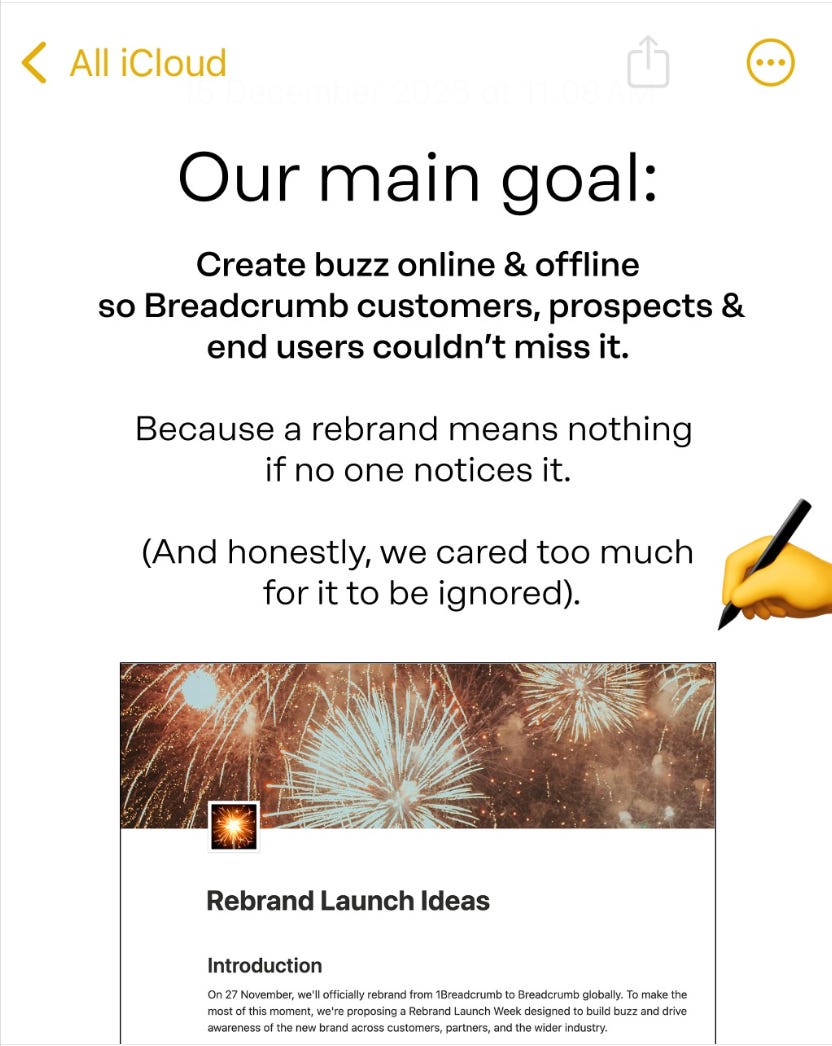
Now, let me draw this picture for you.
When we think of a company doing a rebrand, something marketers say all the time is that the only people who really care about your rebrand are you. And I don’t think they’re wrong. It’s obviously a huge moment internally, we’ve experienced this ourselves at Slate, but trying to make everyone else online care that you changed your logo or colors and stuff is hard.
Of course, the right thinking is to lean on your employees to help carry the message but I think the biggest grip that people often have with this kind of thing is that no one wants to see the same regurgitated post from 30 different employees because some poor social media manager (who is also the team copywriter) handed everyone a doc with 6 variations of “I’m thrilled to announce” paragraphs.
And as I mentioned above, Breadcrumb didn’t exactly have a giant team sitting around waiting, just waiting for a massive social campaign to happen. At the height of the rebrand, the core marketers were already stuck in the throes of rewriting 64 website pages in roughly 6 weeks. They had to update the product and brand across multiple regions, and were already creating assets for more than 70 employees and managing all the internal comms that came with that. Then, about 4 weeks before the actually launch, they remembered that they also need to make something for social.
This would be the time where small teams like Esther’s would start scrambling to produce something fast. They would be pushing the designers to create more graphics. They’d start typing away at the launch copies and then probably spend hours rewriting for each person’s individual tone and voice. They’d probably also be working on how to make it make sense across different channels. All’s to say that this would literally take up way too much time that they didn’t realistically have.
Esther knew there would be no way that they could personally make enough content to give the launch the energy it needed. So instead, they just needed to figure out a way to make this as easy as possible for other people to create.
Their 3-part system
Give everyone context in one place. Esther created a notion page called rebrand hub. It became the centralized spot to house all the information for their team to have context about the rebrand. They included things like FAQs, new brand assets, before & afters of the old vs the new look. This is also where the key messaging lived, and the explanation of why they were dropping the “1” from the company name.
Give people a reason to participate without telling them exactly what to make. Breadcrumb's Content Manager, Anna Fensom did this by creating an internal competition around their launch to encourage employee participation. And instead of rewarding the post that got the most engagement, they said the winner was whoever made the most creative post. Which basically encouraged people to not make the same thing.
Support people making things, and then hype the hell out of them. Esther made it clear that the marketing team would still help when people needed it. And sometimes that meant jumping in to help edit audio, or helping with copy, filming, etc. But the caveat is that the employee had to raise their hand and ask for help rather than the marketing team proactively creating for them. And as the posts went live, they celebrated them internally, which got even more employees involved over the 2 week period. She also mentioned that leadership joined in too which was a big win.
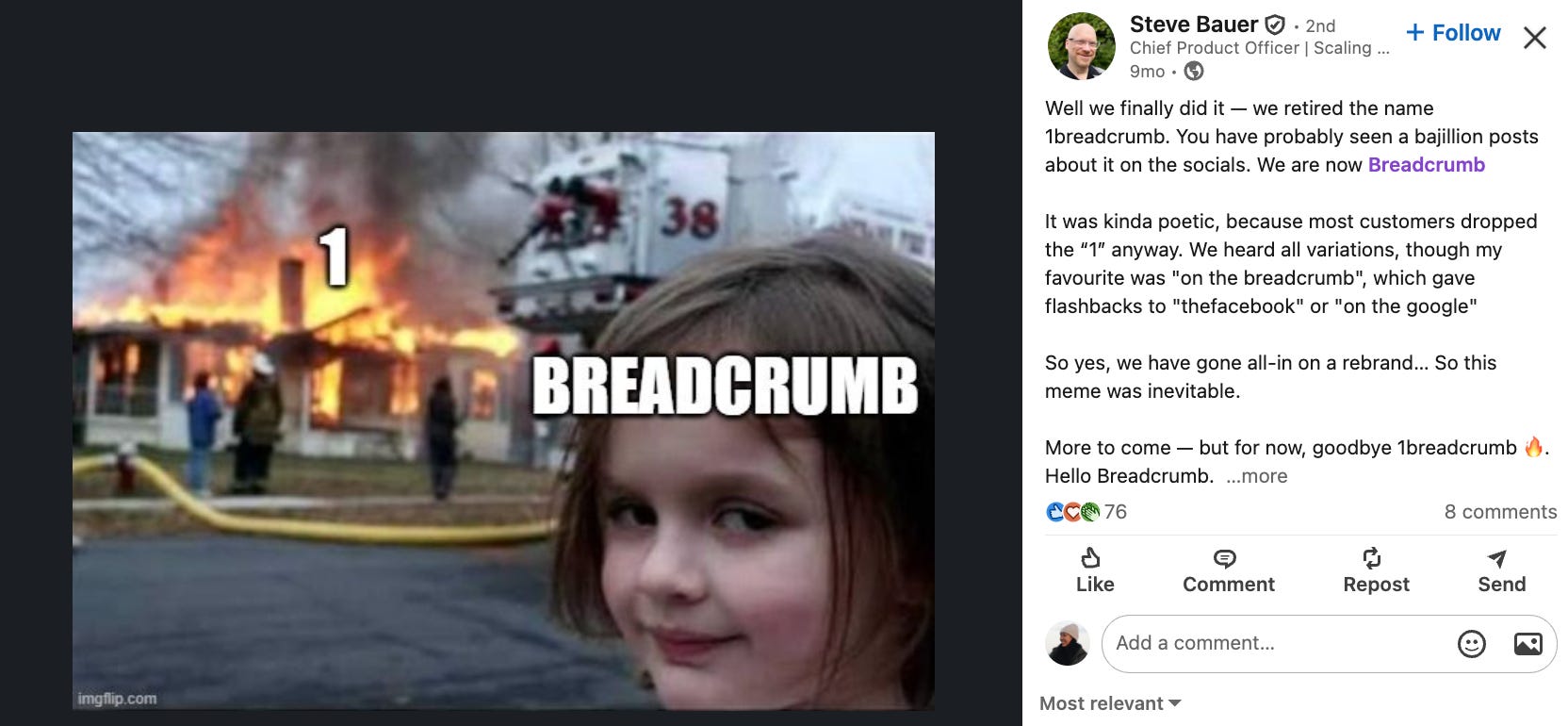
This operating decision led to more than 50 posts in two weeks! And the engagement that they got through their employees’ personal profiles ended up being 5x greater than anything they got through the company page. Esther mentioned that they hadn’t ever done anything like this before, so they didn’t have a benchmark going into the launch. Now this has been something they use internally and carried into other launches.
Now I know a lot of you reading would think that the obvious takeaway here is probably something like, “alright, cool, so let’s do employee advocacy.” Sure, but I think that’s again taking the tactic too literally.
What Breadcrumb did here to make this successful was change what the marketing team was responsible for. They did not own every post. They were responsible for giving context and guardrails, and then they provided any necessary support where people needed it. Then they gave everyone else room to flourish and I think when you have a team member recreating the infamous scene from “Love, Actually”—you’ve won.
And that’s the important takeaway/lesson/whatever you wanna call it here. When you’re running a lean team, you don’t always simply need more people on marketing to create more output. For the most part, the smartest teams get clear about what marketing actually needs to own and then they build enough context and trust to get those folks to help carry some of the work.
Esther’s advice for lean marketing teams
If you read up to here, I’m really impressed because it means you care about this topic a lot. Look, we spend so much time looking at what everyone else is doing that it becomes very easy to feel like we should be doing all of it too. But maybe running a good social team, especially a lean one, is being really about being honest about what you actually have to work with.
Anyway. Here’s to making our boring little corners of the internet a little less boring!
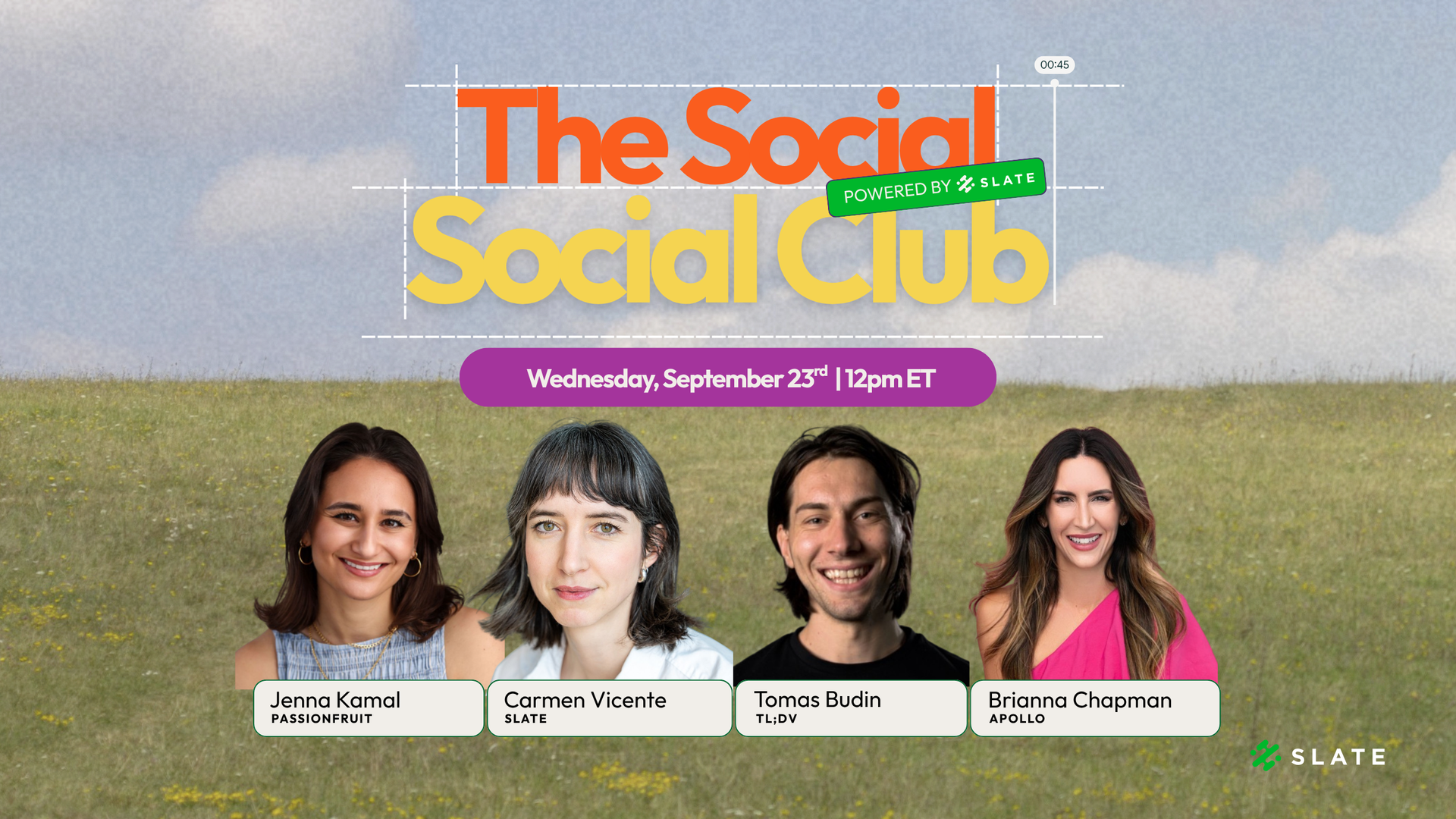
And if you want to hear more from other social media marketers around topic of boring social you should tune into this month’s Social Social Club on Wednesday, September 23 @ 12pm EST.
We’ll be chatting with Tomas Budin (Video Content Creator at TL;DV), Brianna Chapman (Senior Social Community Manager at Apollo), and Jenna Kamal (Events and Community Lead at Passionfruit —three people who consistently make me LOL on LinkedIn—to talk about how they make content interesting when the subject matter isn’t doing them any favors.