


At the ripe age of 36, I’ve accepted that I no longer have the stamina to be as chronically online as I used to be.
My 14-year-old now serves as my daily trends reporter, though his algorithm is not one I would ever naturally find myself in. Still, the number of times someone brings up something happening online and I stare at them like a deer in headlights has become slightly concerning, especially considering part of my job as a Head of Marketing is knowing what people care about.
But it’s not only the internet. I can’t tell whether it’s getting older, having three kids, working a demanding job, or balancing this whole creatorpreneur thing I’ve got going on, but something has noticeably changed. I don’t want to answer text messages. Scrolling makes me tired. Even my thinking feels slower.
It feels like my mind, body, and soul are going through some kind of metamorphosis. I can’t keep blaming it on postpartum. Or can I?
I don’t know. Maybe Mercury is retrograding or something.
Anyway, today, I’m writing about why marketers are much closer to salespeople than many of us would like to admit, and sharing how my team at Slate is operates with a sales oriented mindset.
This article is sponsored by Consensus.
Buyers want to understand your product before they ever talk to sales, which means marketers need better ways to help them explore on their own terms. Consensus helps teams create interactive product tours, on-demand demos, and conversational AI experiences that bring static content to life—allowing buyers to ask questions, uncover what matters to them, and move forward with confidence.
See how Consensus works here
Unfortunately, marketing is also sales

I have this friend who knows absolutely nothing about the tech industry. B2B SaaS sounds like a bunch of gibberish to her, and I’d be lying if I said I wasn’t sometimes jealous of her ignorance of this entire world.
The last time we were hanging out, I was trying to explain what I do as a Head of Marketing when she gave me a blank stare and said, “So…you’re basically selling things to people?”
“Well, technically, yes,” I said. “But I’m not sales.”
Then she asked, very innocently, “What’s the difference?”
Obviously, there is a difference! I’m sure someone much smarter than me could write a very long article explaining exactly where marketing ends and sales begins.
But this is not that article.
Marketers love saying, “I’m not sales.” We say it almost defensively, as though being associated with selling makes the work less trustworthy. Sales gets stereotyped as the aggressive department chasing contracts and commissions, while marketing gets to be the cool, creative team making nice things and “building the brand.”

The higher I’ve moved in marketing, though, the more I’ve realized how much of the job is selling. We may not be the ones handling contract negotiations or chasing someone for a signature, but we are constantly trying to convince people to do something. We want them to stop scrolling, pay attention, sign up for something, come to an event, watch a demo, reply to an email, or reconsider how they’re currently doing their work.
I think marketers sometimes work so hard to prove that we are different from sales that we forget we are still supposed to help people buy into our business. That doesn’t mean everything we create has to end with “book a demo.” It does not mean brand, community, or creativity suddenly become not as important or irrelevant because they cannot always be traced neatly to a closed deal. It just means there is a commercial purpose behind the work, and I don’t think acknowledging that is a bad thing.

When I look at how my marketing team operates at Slate, there are plenty of situations that got blurred between marketing and sales.
Our core audience is social media marketers, which also happens to be the world my team and I have worked in for years. We understand their jobs, the problems they deal with, the way their teams operate, and the language they use to describe their work. In many cases, the people we want to reach already follow one of us. Or they’ve engaged with our content, attended our events, or exist somewhere in our broader ecosystem.
And because of that, there are times when it makes more sense for someone from marketing to reach out directly.
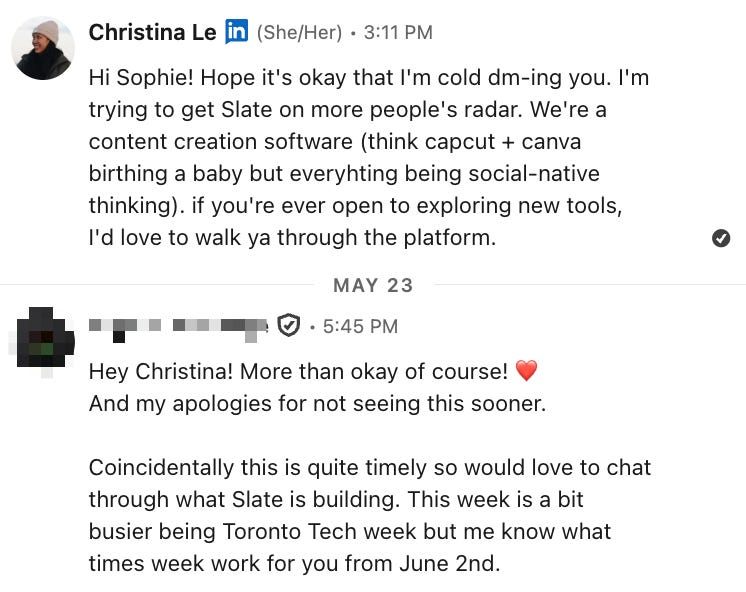
We are not necessarily putting them through a perfectly sequenced outbound campaign or approaching the conversation like a traditional sales prospecting exercise. Sometimes it is as simple as saying, “Hey, I know what your team is working on, and I think this could actually be useful. Do you want to see it?”
We generally get a good response, even when we are straightforward about wanting to show them the product. Part of that is because the outreach comes from someone they recognize, but I also think it is because we can approach them as marketers first. We understand the work because we have done it ourselves. The conversation starts with the problem rather than the software, and there is already some level of trust before anyone gets on a call.
Our events operate in a similar way.
We host breakfasts, dinners, webinars, happy hours, and other gatherings for people working in social and content. They are genuinely meant to bring interesting people together, and I believe there is real value in building that community. We are also a business, and we go into those events hoping that some of the people we meet will eventually become customers.
Both things can be true!
Sales teams have been taking prospects and customers out for dinner forever. Marketing does something similar, except we tend to give the event a name, make a landing page for it, and invite more people. We are not usually sitting across the table from someone and asking about their budget or procurement process. We are creating an environment where they can meet us so they can understand how we think, and see that we care about the same things they do. We talk about their work, their teams, and the problems they are facing. And then somewhere in that conversation, we may also relay how Slate could help.

After the event, the relationship does not transfer cleanly from marketing to sales. We send our sales team the names of the people we spoke with, along with whatever context we gathered. Who seemed interested? What are they currently struggling with? Is there a real use case? Did they mention something that would make a follow-up more relevant?
Sometimes sales asks us to reach back out because we have the stronger relationship. Sometimes we make the introduction. A lot of times, we join the demo because we were the ones who invited the person, or we may have an existing connection with them.
In that sense, we occasionally operate a little like BDRs/SDRs. We identify people who may be a fit. Then we start the conversation and qualify some level of interest, and then bring sales in when it makes sense. The difference is that the relationship was often created through content, or community familiarity rather than a cold email.
Our presence on a demo can also change the quality of the conversation. We know a lot of context of the person and their team, or the reason they agreed to take the call. We can speak to the marketing goals behind the use case and explain the product in the context of how the work actually gets done. That personal tie makes the process feel less like a handoff and more like a continuation of the same conversation but we’re buddying up with our sales team.
That is a softer form of selling, but it is still selling.


The same is true of our product marketing. We make content that explain what Slate does without making every piece feel like an advertisement. We try to make the product interesting enough that people want to click and actually watch. We show the problem in a way that feels familiar and help people understand how the product could fit into their work.
Our goal is still to move someone closer to buying. We are simply doing it in a way that recognizes most people do not enjoy feeling like they are being sold to. Something that we’ve learned working in organic social.
None of this means every marketer should become an SDR or that every creative idea needs to produce an immediate demo request. It also does not mean marketing should become a service department that exists solely to fill the sales team’s calendar. There is a reason the functions are separate, and marketing has responsibilities that extend far beyond supporting individual deals.
But I think there is something powerful about a marketing team that understands how revenue is created and is willing to participate in that process.
For a long time, marketers have been made to feel as though we have to choose what kind of marketer we want to be. You can be a demand marketer who cares about pipeline, or you can be a creative marketer who cares about the brand. Focus too much on demand and you worry the work will become boring and transactional. Lean too far into creativity and you worry the rest of the business will stop taking you seriously.
In practice, the strongest marketing work usually sits somewhere in the middle. It creates interest without stripping all the personality out of the idea. It builds relationships that make the sales process easier. And it understands when to hand someone over to sales and when marketing’s involvement can help move the conversation forward.
Maybe the difference between marketing and sales is not as complicated as we sometimes make it. Sales is generally responsible for turning an active opportunity into a customer. Marketing creates the conditions that make someone willing to have that conversation in the first place.
But both functions are ultimately asking someone to believe that what you are offering is worth their time, attention, and mooooney.
So yes, technically, I am selling things to people.
I just make it look a little prettier.
my goodness, i feel you on the brain drain of social media. I personally attribute this to AI usage in my consulting role as a PM. It saps all my creative juices before I sit down to write or work in a way a previous high degree of social consumption had not before.
Peter Drucker wrote, "the aim of marketing is to make selling superfluous. The aim of marketing is to know and understand the customer so well that the product or service fits him and sells itself." (although I'm not sure how much sales people like that framing.)
I like to say marketing is everything between "I have no idea who you are or what you do" and "I'm probably ready to buy something."